Icons by Nikodim Pavlovich Kondakov
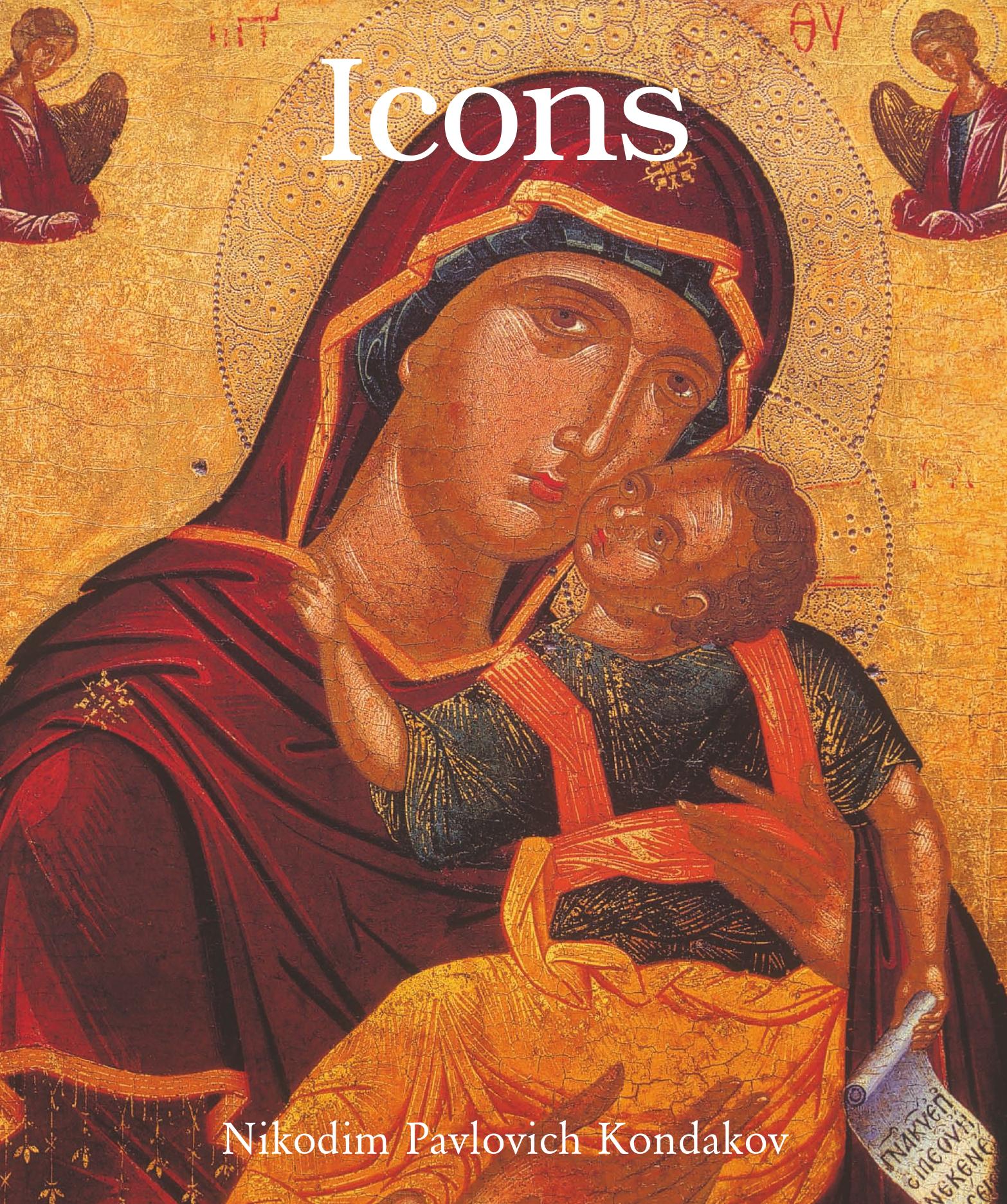
Author:Nikodim Pavlovich Kondakov [Kondakov, Nikodim Pavlovich]
Language: eng
Format: epub, pdf
ISBN: 9781783107001
Publisher: Parkstone International
107. The Crucifixion, c. 1500. Egg tempera on
lime tree panel, 85 x 52 cm. From a monastery
near Vologda. The State Tretyakov Gallery, Moscow.
108. The Entry into Jerusalem, Moscow,
middle of the 16th century. 71 x 56 cm.
The State Tretyakov Gallery, Moscow.
But he new styles at Nóvgorod and probably at Pskov, were evidently quite different in character and can be recognized not in wall-paintings but in icons. Indeed, from this time on, the iconic manner takes the lead and dominates wall-painting and ochre becomes the commonest colour. If then we confine ourselves to the icons, we may first take the various parts of a great icon of the Last Judgement, and the Life of S. George in the side scenes of a large icon of the saint. The icons awake admiration by the beauty of their sky-blue grounds, the elegance of the patches of colour, and the brightness of the rich trappings. We have already observed that this brightness and patchiness appeared in eastern icons in imitation of western art, which emphasised the decorative element under the influence of decorative processions, triumphs, theatrical representations, and mystery plays[137]. This is the moment when, instead of the simple ‘Apostolic’ clothes, a chiton and himation, usually light blue and dark mauve, Angels and Arch-Angels are vested in magnificent albs and gold dalmatics, and Christ Himself is represented in splendid vestments with a tiara upon His head, whence arose in the east the symbolical figure of Christ the Great High Priest. This all worked in with the mystical literature of ‘Visions of Paradise’, such as are introduced, for instance, into the ‘Life of S. Basil the New’[138], gates of the heavenly Jerusalem of bright crystal, beings like shining stars, youths clothed in fire, the white throne of God and round it youths vested in crimson, the mansions of the saints in various colours, full of flowers, with golden floors, emerald pillars to the halls, everywhere men in garments white as snow or pure as wool, their faces shining like the moon in the darkness of night. All this is apt to fall into absurdities, such as saints with their brows inscribed in letters of lightning, ‘Prophet’, ‘humble in spirit’, and sinners with their heads marked in red with the deeds of each ‘Thief’, ‘Murderer’, ‘Adulterer’, ‘Sorcerer’, and the like. This last detail answers to a new taste in icons for in-scriptions in tiny letters giving the names of people or groups. The second icon, the Life of S. George[139], is remarkable for setting forth the doings of the chivalrous hero and martyr in the most dramatic way. He is portrayed as a tender youth, almost a boy, so as to make a more effective contrast with the rude barbarians his torturers. These the Nóvgorod painter has plentifully endowed with tall stature, wild faces, and savage gestures, and in them one may see types of the Nóvgorod democracy.
The icon of the Six Days it is both a splendid example of late fifteenth-century execution and interesting for the refashioning of old compositions and types.
Download
This site does not store any files on its server. We only index and link to content provided by other sites. Please contact the content providers to delete copyright contents if any and email us, we'll remove relevant links or contents immediately.
The Art of Boudoir Photography: How to Create Stunning Photographs of Women by Christa Meola(18634)
Red Sparrow by Jason Matthews(5478)
Harry Potter 02 & The Chamber Of Secrets (Illustrated) by J.K. Rowling(3677)
In a Sunburned Country by Bill Bryson(3546)
Drawing Cutting Edge Anatomy by Christopher Hart(3531)
Figure Drawing for Artists by Steve Huston(3454)
Harry Potter and the Prisoner of Azkaban (Book 3) by J. K. Rowling(3363)
The Daily Stoic by Holiday Ryan & Hanselman Stephen(3326)
Japanese Design by Patricia J. Graham(3182)
The Roots of Romanticism (Second Edition) by Berlin Isaiah Hardy Henry Gray John(2920)
Make Comics Like the Pros by Greg Pak(2918)
Stacked Decks by The Rotenberg Collection(2884)
Harry Potter and the Deathly Hallows (7) by J.K. Rowling(2728)
Draw-A-Saurus by James Silvani(2720)
Tattoo Art by Doralba Picerno(2673)
On Photography by Susan Sontag(2641)
Churchill by Paul Johnson(2587)
The Daily Stoic by Ryan Holiday & Stephen Hanselman(2580)
Drawing and Painting Birds by Tim Wootton(2512)
